_edited.png)
Radical Self-Love
- radiantheartbrooma
- Feb 8
- 3 min read

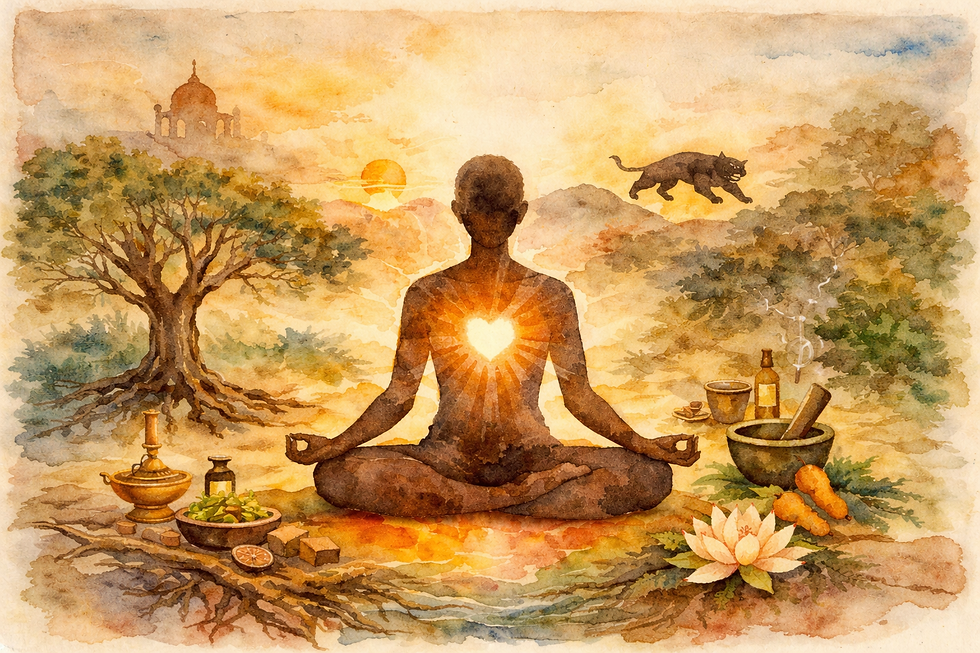
Returning to the Root
Self-love did not begin as a trend. It was never meant to be loud, indulgent, or isolating.
In ancient Greek philosophy, oikeiosis described self-love as the source of ethical life. Care began with the self, then naturally extended outward to children, family, community, and eventually humanity. Not as self-absorption, but as orientation. When the self is tended, love has somewhere steady to move from.
Centuries later, thinkers like Erich Fromm echoed this understanding. Loving oneself and loving others are not opposing acts. They are inseparable. The capacity to love outwardly is shaped by the quality of relationship we hold inwardly.
Long before psychology attempted to define it, mystics spoke of this return in quieter language. Rumi wrote not about fixing the self, but about remembering it:
Return to the root of the root of your own soul. Not improvement. Not optimization. Return.
Buddhist traditions reflect this same understanding. In loving-kindness practice, compassion begins inward, not as indulgence, but as preparation. The heart learns safety before it learns generosity.
And yet today, self-love is often misunderstood. It is frequently framed as consumption, self-focus, or withdrawal from relationship. When detached from rhythm, responsibility, and tradition, it loses its regulating quality and becomes shallow.
But this is not its origin.
What if self-love is not something we add on, but something we remember how to live?
The Ayurvedic Understanding of Self-Love
Ayurveda has always treated self-love as foundational.
Not as affirmation. Not as indulgence. As alignment.
Ayurveda teaches that each person arrives with a unique constitution, a specific arrangement of energies, tendencies, and rhythms. Health is not conformity. It is coherence. Learning how to live in relationship with your own nature.
From this perspective, the body is not something to conquer or transcend. It is the vehicle through which purpose unfolds.
Self-love, then, is not a feeling. It is a practice of non-violence toward oneself. In thought. In habit. In rhythm.
When we override our needs, ignore our limits, or speak harshly to ourselves, Ayurveda understands this as creating imbalance. Over time, this imbalance accumulates as ama—not only physical toxins, but emotional and psychological residue.
Care clears accumulation. Rhythm restores intelligence.Attention becomes medicine.
The practices below are not indulgent rituals. They are stabilizing ones. Simple ways of restoring communication between body, mind, and breath.
Simple Ayurvedic Rituals for Self-Love, Mood, and Pleasure
Daily rhythm
Dinacharya, or daily routine, is not rigidity. It is reassurance. When the body knows what to expect, the nervous system softens. Consistency itself becomes care.
Moving with the day
Waking earlier aligns the body with clarity and lightness. Evening invites slowing. Rest before the body enters its most restorative hours supports deeper repair. This is not discipline. It is timing.
Eating with awareness
Digestive strength peaks mid-day. Nourishment is best received when the body is ready. Lighter evenings support rest. Walking after meals supports assimilation, both physically and energetically.
Oral cleansing
Oil pulling and tongue scraping are acts of refinement. Clearing what accumulates overnight prepares the body to receive the day with more clarity.
Self-massage
Warm oil applied with attention nourishes tissues, calms the nervous system, and reinforces safety through touch. This is care without explanation.
Movement and breath
Yoga postures paired with breath are not about performance. They are about circulation, sensation, and emotional release. Heart-opening shapes invite vulnerability through support, not force.
Kind speech
The body listens. Even when belief lags behind language, gentler speech begins to re-pattern internal response.
Warm water
Simple. Ancient. Effective. Warm water supports digestion, circulation, and elimination. Sometimes care is unremarkable.
Scent and plant allies
Aromatic plants work directly on the nervous system. Roots ground. Flowers soften. Resins protect. Scent bypasses intellect and restores regulation.
Rest as practice
Yogic sleep is not collapse. It is conscious restoration. A state where the body repairs and the mind releases effort. Rest here is intentional.
Self-Love as Preparation
Self-love does not end with the self.
When the body is resourced, the heart steadies. When the heart steadies, attention widens. When attention widens, care becomes relational again.
Across traditions, self-love has always been understood as preparatory. A way of becoming capable of presence, clarity, and connection.
Not an escape from life. A way of meeting it with integrity.
Return to the root. Care for what carries you. Let that care move outward naturally, without performance, without needing to be named.


Comments